When You Feel Like a Helpless Little Dove
When Life Leaves Us Exposed
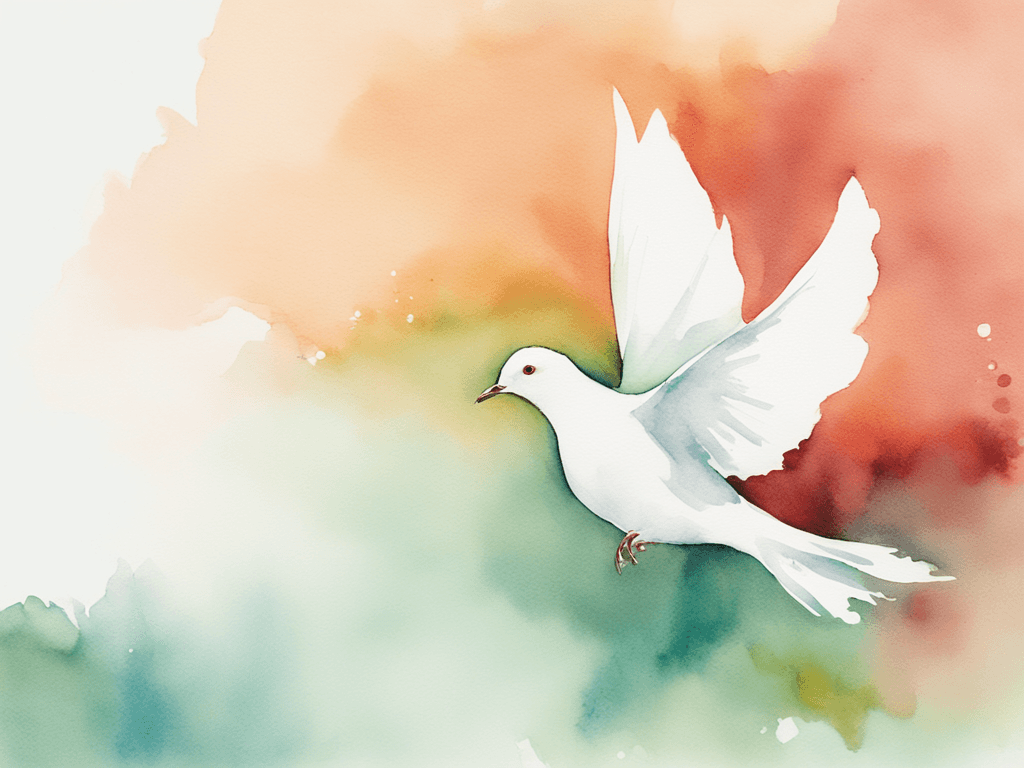
I remember that day perfectly. I was sitting in the hospital waiting room, waiting for news about my mother, when I saw a little dove trying to protect itself from the heavy rain outside the window. It was huddled under a small leaf, trembling, completely exposed to the elements. At that moment, that scene was exactly how I felt: small, vulnerable, at the mercy of circumstances I could not control.
Have you ever felt that way? Like a defenseless dove in the midst of a storm? Perhaps it was during a financial crisis that knocked the ground out from under you. Or when you received a frightening medical diagnosis. Or when you lost a loved one and the world seemed to crumble around you.
These are the moments when Psalm 74:19 becomes more than ancient words on a page — it transforms into a cry that wells up from the depths of our soul: "Do not deliver the life of your dove to the beasts; do not forget the life of your afflicted forever."
A Broken Nation and a Desperate Cry
To understand the depth of this verse, we need to walk through the rubble that surrounds it. Psalm 74 is not a prayer from a sunny Sunday — it is a lament born among smoking ruins. Israel had just witnessed the destruction of the temple, the place where God's presence dwelled among them. Imagine the shock: the sacred walls torn down, the instruments of worship profaned, the silence where there once were songs.
The psalmist looks around and sees a scattered, oppressed, forgotten people. And in the midst of this devastation, he uses a powerful image: the dove. In Hebrew culture, the dove was not just a bird — it was a symbol of Israel, of the Holy Spirit, of purity and vulnerability. A defenseless creature, without sharp claws or a strong beak to protect itself.
Here lies the painful beauty of this text: when we are too broken to find eloquent words, when systematic theology does not reach the depths of our pain, God gives us permission to cry out like that dove — honestly, desperately, without masks.
The Truth About Our Fragility
We live in a culture that idolizes strength. On social media, everyone seems to be conquering the world. At work, we are pressured to always show confidence. Even in some Christian circles, there is a subtle pressure to have a "strong faith" that never wavers, never questions, never cries.
But the Bible tells us a different story.
It shows us a David hiding in caves. An Elijah wishing to die under a juniper tree. A Peter weeping bitterly after denying Jesus. An early church being persecuted and scattered. And a Jesus who, in the Garden of Gethsemane, sweated drops of blood in the face of the anguish that was approaching.
Vulnerability is not the opposite of faith — sometimes, it is the most honest expression of it.
When you recognize that you are like a dove, when you admit that you do not have enough strength on your own, you are actually positioning yourself in the exact place where God's grace operates with the greatest power. Paul learned this when God told him: "My grace is sufficient for you, for my power is made perfect in weakness" (2 Corinthians 12:9).
Think about it: In what area of your life have you been trying to appear stronger than you really feel?
The God Who Never Forgets
The second part of the verse is where we find our refuge: "do not forget the life of your afflicted forever." The psalmist is not just expressing pain — he is anchored in a deep truth about God's character.
Let me tell you about Sara, a sister from the church where I congregated. She went through a period of unemployment that lasted almost two years. In the first months, many people offered help and prayers. But as time passed, the calls decreased, the invitations stopped, and she felt increasingly invisible.
"It was when I understood what it means to be forgotten by people," she told me. "But it was also when I discovered that God has a different memory. He does not forget when the cameras turn off and the novelty wears off."
The verb used in Hebrew for "forget" carries the sense of neglecting, abandoning, leaving aside. The psalmist is saying: "God, I know that people may abandon us, but You are not like them. Do not forsake us!"
And here lies the foundation of our hope: God does not operate with the selective memory that characterizes human beings. Isaiah 49:15-16 assures us: "Can a woman forget her nursing child, that she should have no compassion on the son of her womb? Even these may forget, yet I will not forget you. Behold, I have engraved you on the palms of my hands."
You are engraved on the palms of God's hands. When He looks at His hands, He sees you. This is not a beautiful metaphor — it is an unshakeable promise.
From Doves to Protectors
But Psalm 74:19 does not only call us to receive protection — it challenges us to reflect God's protective heart. If God does not forget the vulnerable, how can we, created in His image, ignore them?
Jesus was radical in this aspect. In Matthew 25, He says something that should make us tremble: "Truly, I say to you, as you did it to one of the least of these my brothers, you did it to me." Caring for the vulnerable is not optional philanthropy — it is finding Christ in the faces of those society forgets.
Proverbs 31:8-9 commissions us: "Open your mouth for the mute, for the rights of all who are destitute. Open your mouth, judge righteously, defend the rights of the poor and needy."
How can you be God's answer to someone who feels like a dove today?
Transforming Theology into Life
Allow me to offer practical ways to live out this truth:
1. Practice authentic vulnerability in community. This week, choose a trusted person and honestly share an area where you feel vulnerable. There is no spiritual power in pretending to be strong when you are not. James 5:16 invites us to confess our weaknesses to one another — it is in that transparency that we find healing.
2. Adopt a "dove" in your life. Identify someone around you who is going through a difficult time — it could be an elderly neighbor, a single mother from church, a teenager struggling with depression. Commit to being a constant presence, not just in the first days of the crisis, but especially when the novelty wears off and everyone has forgotten. Send a weekly message, offer practical help, pray consistently.
3. Create a "garden of lament" in your prayer routine. Set aside a specific time — it could be five minutes every morning — to bring before God the vulnerable: refugees, orphans, the persecuted, the sick, unjustly condemned prisoners. Use Psalm 74:19 as your base prayer. Pray with the Bible open, reminding God (and yourself) of His promises.
4. Turn indignation into action. When you read news about injustice or vulnerability, do not just scroll past. Ask: "What can I do?" It could be donating to a trustworthy organization, writing to political representatives, volunteering a few hours a month at a shelter, or using your profession to serve the needy for free.
Verses to Memorize and Meditate
As you walk through this journey of recognizing your own vulnerability and extending protection to others, let these passages shape your heart:
Psalm 91:14-16 — "Because he holds fast to me in love, I will deliver him; I will protect him, because he knows my name. When he calls to me, I will answer him; I will be with him in trouble; I will rescue him and honor him. With long life I will satisfy him and show him my salvation."
Matthew 5:7 — "Blessed are the merciful, for they shall receive mercy."
Isaiah 41:10 — "Fear not, for I am with you; be not dismayed, for I am your God; I will strengthen you, I will help you, I will uphold you with my righteous right hand